The texts: Philippians 2 and the story of the Caterpillar from Adventures of Alice in Wonderland by Lewis Carroll.
Last week we read that Paul didn’t care why preachers were preaching about Christ, whether it was from selfish ambition or from a pure heart. This week we read that Paul requests those in the church at Philippi, and by extension us as well, to not do anything from selfish ambition. Neither should we do things from conceit. Paul teaches that we also shouldn’t murmur or argue. This description of having a good attitude and maintaining harmonious relationships with each other Paul summarizes as “holding fast to the word of life.” This legacy that he leaves will enable him to boast on the day of Christ that he did not run or labor in vain. Even though this legacy is what is causing him to be imprisoned, he says it is what makes him rejoice.
October is Queer History month. October wasn’t always a month to commemorate the history of queer people in the United States. It was established in the early 1990’s, in part due to October 11th already being Coming Out Day. Coming Out Day was instituted in 1989. What preceded all of this, though, were the Stonewall Riots and a gay rights movement led in many ways by Sylvia Rivera. Ms. Rivera was a genderqueer drag queen who threw one of the first bottles at the cops who were invading their sanctuary, a bar called the Stonewall Inn. Sylvia suffered for the freedom of queers, especially the youth.
Paul and Sylvia – an unlikely combination to some, but a natural one for me - both helped to spearhead a movement of rag-tag people trying to figure out the best way to live life. Both were ridiculed by people both in the movement and outside of the movement. We are the legacy of both these pioneers. How we handle ourselves now reflects on the work they did then. What we do today leaves a legacy for those who follow us.
Sylvia and Paul both knew that people had to change. The people they were speaking to had to change from being weak to being strong and they had to change from being selfish to being selfless. I struggle with how to talk about how we can be meek and not weak. I know that we need to be self assertive and not selfish. I believe we need to put others first while we make sure to take care of ourselves. The revolutions that Sylvia and Paul were leading required people to walk this line. Knowing who you were was the only way to be able to truly put others first.
Jesus knew who he was. He took care of himself by stealing away to the mountains to pray so that when the throng pressed he could be strong. When he didn’t have an answer to a question, he would say he didn’t know. He was grounded in his faith and in the reality of who he was and in his mission. People called him King, but he knew his title, whatever it was that they decided to call him on any given day, did not and could not dictate the choices he made or the way he moved through the world. If he was a King, it was not as the world understood Kingship. If he was a bringer of Peace, it was not as the world knew peace. He was reconstructing ideals and expectations.
This is the legacy that Jesus left Paul. Paul taught this radical restructuring to the Philippians. Sylvia taught her radical restructuring of what it meant to be a queer person of value to the homeless queer youth in New York City. She was, by most accounts, considered to be a freak. She was not defined by the heterosexist society outside or inside of her sub-culture. Paul and Sylvia wanted to see change. They left us a legacy of walking in the tension between being confident in themselves and what they knew to be true, and giving all they had for the sake of the radical restructuring they knew needed to happen.
Change is hard. Depending on what the change is – how extreme or in what aspect of our being – we might believe, like Alice, that we don’t even know who we are anymore. The Caterpillar asks Alice, “So you think you’ve changed, do you?” She replies, “I’m afraid I am, Sir.” But there is change and there is change. The change that Alice was experiencing, or at least what she was describing to Caterpillar, was not convincing him that she was undergoing true change.
Alice feels like she’s changed so much that she doesn’t know who she is anymore. Caterpillar is suggesting that she hasn’t really changed at all. Each of them has a different definition of change. Both of them are influenced by what change has been and meant in their past. I don’t think we have the right to decide for someone else if their change is true change, however, sometimes an objective opinion is helpful when we are looking at ourselves. Regardless of what Caterpillar thinks, Alice doesn’t feel like she knows herself anymore. She has become very large and very small over and over, and when she tries to recite stories that she knows well, the words are changed and unfamiliar to her. The legacy that she knew to be hers was altering. The stories that she knew were changing. Her perspective of the world changes with her size. All that she expected, because of what she had previously known, she could not count on anymore.
Paul, I believe, is asking us to participate in a similar shift of expectations. He instructs the Philippians to not give up their joy because it results in his imprisonment, but rather to maintain their joy so that his imprisonment is not in vain. Sylvia Rivera might have played the social game better and become a charismatic leader with an influential following. But for her, true change was not buying into a system for the sake of rising higher in ego or status. She wanted to see people free to be who they really are, regardless of how they would be accepted – regardless of who the mainstream of society or even a movement wants people to be.
Alice learned how to be Alice in the world of Wonderland. Paul learned how to be Paul and Sylvia learned how to be Sylvia. Sometimes in order for us to grapple with our future, we need to look at our legacy – the one left to us and the one we are leaving for others. I think change itself is one of our most prominent legacies, both in our faith walk and in our queer social rights movement. Change in the form of evolving.
Plus, we are in a world that has a value system much different than ours. We need to constantly be evolving away from assimilating into that system and remember who we are and what we value. Paul is concerned that the Philippians will be influenced by those preaching Christ for the sake of seeking their own self interests. As much as he says he is glad that Christ is preached regardless of motive, he clearly doesn’t plan on sending these folks to minister to his flock. He is very particular about who he sends while he is away. Timothy, he says, is the only one left who he can trust to send. But then he mentions Epaphroditus, who he also trusts. Paul sometimes is given to a bit of hyperbole. The point is, though, that he doesn’t trust the legacy he is leaving to just anyone. Paul may also have a control issue. I don’t know how tight of a grip we should have on these kinds of things. I think being mindful of our legacy, the one we’ve received and the one that we are leaving, is crucial. I don’t believe in micro-managing. I think that we need to allow people to have agency and to listen with their own critical ears.
I was reading a piece from the American Baptist Church, USA’s website. It is called: 10 Facts You Should Know About American Baptists. Point number 4 is this:
American Baptists believe that the committed individual Christian can and should approach God directly, and that individual gifts of ministry should be shared. American Baptists hold that all who truly seek God are both competent and called to develop in that relationship. They have rejected creeds or other statements that might compromise each believer’s obligation to interpret Scripture under the guidance of the Holy Spirit and within the community of faith. American Baptists also celebrate the special gifts of all believers, testifying that God can use each of us in ministry.
I want to highlight two of these sentences. The first is: “American Baptists hold that all who truly seek God are both competent and called to develop in that relationship.” The second is: “American Baptists also celebrate the special gifts of all believers, testifying that God can use each of us in ministry.” I believe this. This is a part of the legacy that we are to live into. Paul speaks to this ideal often when he talks in his letters. Jesus sent his disciples out often and expected them to be competent in their ministry.
We don’t have to have any more of a special anointing or calling to share our special gifts and to cultivate our own relationship with our Divine Beloved, than the anointing of being made in the image of our Creator and the calling of our hearts to participate in community.
Paul and Sylvia did not wait to be perfect before they began their work. The truth is, most of the time we are all like Alice, not knowing who we are because we are changing so much, but we will not stay there. We must remember our legacy, and that part of our legacy is to go through these evolutions – to go through these changes. Let us be mindful of who we are, who we think we are, and who we are to become. This is our journey – our calling. We are to walk the line of being strong and being meek; of being confident and being other-centered. We need to be mindful of our needs, our weaknesses and our strengths as we “work out our own salvation,” so that we can be free to share everything that we have. This is our legacy.
Monday, October 06, 2008


Thursday, October 02, 2008
Concern for Queer Homeless Youth
Recently I wrote/preached about an idea to start a garden as a way to engage queer homeless youth in Chicago. Today I came across Coffee and Gender's, Thursday, 09-25-08 post, Support the Memoirs of Homeless Queer Youth
If you are concerned about youth queer homelessness, please read the post, watch the videos (they are each less than 2 minutes), and check out the website http://kickedoutanthology.com/.
Thanks Mike, for posting this.
If you are concerned about youth queer homelessness, please read the post, watch the videos (they are each less than 2 minutes), and check out the website http://kickedoutanthology.com/.
Thanks Mike, for posting this.
Monday, September 29, 2008
Why worry about church songs?
Why should I be so concerned about black/white imagery in church songs? You know the imagery, right? Black equals sin and white equals purity. Black equals confusion and white equals clarity. Black equals wrong and white equals right. Black equals Satan and white equals God. It's just a metaphor ... right?
Hell no!! White people - pay attention. This is important.
Thanks to Harriet's Daughter for posting this video.
Hell no!! White people - pay attention. This is important.
Thanks to Harriet's Daughter for posting this video.
Sunday, September 28, 2008
Curiouser and Curiouser
Philippians 1:1 - 30 and Alice's Adventures in Wonderland*
The difference between Paul and Alice, is that Alice knows that her world has become strange and is astonished by it, while Paul knows that his world has become strange and believes things to have finally turned right-side-up. He knows it's strange to other people because he says things like this is verse 12:
I want you to know, beloved, that what has happened to me has actually helped to spread the gospel, so that it has become known throughout the whole imperial guard and to everyone else that my imprisonment is for Christ; and most of the brothers and sisters, having been made confident in the Lord by my imprisonment, dare to speak the word with greater boldness and without fear.
Paul knows that to most people that is going to sound odd, but he explains it as if they shouldn't be astonished. He doesn't say, "Isn't it amazing?" or "As odd as it sounds..." He says that he wants them to know that this is a good thing, because they seem confused and concerned.
Paul also talks about being "hard pressed between" the notions of wanting to live or wanting to die. Now, I have had similar moments in my life. Some of these moments have lasted years, but I wasn't so upbeat about it. He sees advantages to both and just can't decide which he prefers. My decision was far more tortured than that. I am going to take a guess that for those of you who have also struggled with that same question, it wasn't about which wonderful thing you preferred. So Paul's thinking through this, for most of us, may seem a little abstract or distancing.
Alice is sure that she wants to have this experience in Wonderland, but she is equally sure that she doesn't want to live there. She loves the adventure and she loves the stories that she will be able to tell, but she knows that she wants to go back to the world where she feels like she belongs.
What Alice and Paul have most in common is their tenacity. They try something, there's a consequence - sometimes pleasant and sometimes not. They try something else and see what happens then. They learn from the consequences and just keep going. When Paul learns, though, it leads him to conclusions. When Alice learns, it most often leads her to want another adventure so she can learn some more. Alice does come to some conclusions during the course of the story, but what I notice is that her astonishment and curiosity never goes away. She notices the changes and the oddness. She seems to almost revel in it. And her desire is for more. She doesn't want things tied up in a neat bow. The story doesn't end with an answer to a question or a resolution to a problem. Wonderland goes on as strange and dysfunctional as it did when she arrived. The conclusion is that she has stories to tell and that she can make connections with people and situations that others can't because of the experiences that she's had.
Both Paul and Alice go through a lot of changes in the way they think about things, in their perception of what's real , and in their environments. Paul's Wonderland is the reality that he invites people into. Alice's Wonderland is a reality she stumbled into.
Paul lives in a strange world that is very curious to me. In verses 15 - 18 he talks about the different motives people have for proclaiming Christ. His attitude is that however it's done, regardless of the motive, he is rejoices that Christ is proclaimed. I'm not so generous most of the time. I think motive is a big deal because I think it frames how we talk about things. For instance, Paul says some folks preach Christ out of selfish ambition, not sincerely but intending to increase his suffering. People who would do this seem to me to be apt to preach Christ out of other selfish ambitions too. It's hard for me to say, "What does it matter?" with Paul.
I have to be more like Alice when I stumble into Paul's Wonderland. I have to watch more and listen more. Why is it okay with Paul for Christ to be preached out of selfish ambition? That's curious to me. And what of his imprisonment actually encouraging others to speak out rather than making them afraid to? Why is it a privilege, in verse 29, to suffer with Christ? I have to be more like Alice and not judge these ideas based on the way that I have been taught to think, but look at Paul's life and environment.
Thinking like Alice, though, doesn't mean agreeing with everything. She did not adapt everything that she saw in Wonderland to her life back home. She saw fabulous things ... incredible things. She interacted with beings very much unlike herself. She made mistakes and offended some of the beings as she learned to navigate this new place, but she figured out how to be Alice in a new world - a world unlike her own.
Paul starts his letter to the Philippians saying that he is confident that the one who began a good work in this community and in this people would bring it to completion. Paul is confident for this community. That encourages me also. I need someone to be confident on my behalf. I am confident on behalf of this community. I believe that what was begun has been and will continue to be fruitful. In Paul's words, I think we will produce a harvest of righteousness. But there are curious juxtapositions of belief and suffering, of living worthily and striving, and of living in the tension between life and death in this faith journey.
I want us to remain more like Alice - astonished and curious. I want us to take in all the conflicts and contradictions of this journey of faith that we are on, and be the best us that we can be in all the strange situations we end up in. I don't want to us assimilate into someone's idea of Christianity or buy into popular myths about Jesus.
We need to be us, to not resist change but to resist assimilation, and to observe everything that we can and say, "Curiouser and curiouser." Making hard and fast decisions and insisting on reducing life to polarized opposites does not seem like the teachings of Jesus to me. We may flounder and offend sometimes, but I am confident that we can learn to know ourselves, live as ourselves, and walk through this strange dysfunctional world while we participate fully.
*Carroll, Lewis. Alice's Adventures in Wonderland. New York: Ariel Books/Alfred A. Knopf, 1983. Pages 20 - 25
Wednesday, September 24, 2008
Unexpectations
Acts 6
This week, as I was waiting for the Metra, I saw something that I didn't expect. There was a row of Queen Anne's Lace next to the train tracks. They were growing in the rocks next to the steel. It was inspiring. It made me feel like anything was possible. I have similar feelings when I see dandelions growing in sidewalk cracks or daisies growing in a paved parking lot. If they can push through and live then so can I.
Seeing those flowers unexpectedly made me think about what I did September 11th. I wanted to do something positive and life-giving. I wanted to turn around the inertia of hate - the hate of racial profiling, the hate of revenge, the hate of self-righteousness. I decided that the best way for me to do this was to plant some seeds. I brought my planters upstairs and bought some seeds and some potting soil. After putting the seeds into the soil, I watered them and set them in the sun. I did all that I knew how to do to make the conditions right so that these seeds would grow. Some of them have. Some of them haven't. Maybe they haven't yet, but it looks like the seeds didn't take.
I don't know if I did something wrong for those seeds or what, but those pots are just full of dirt with no sprouts. It happens. And apparently it also happens that Queen Anne's Lace grows alongside the railroad tracks sometimes.
Although I planted my seeds with the best of care, I also planted them at the wrong time of year. I'm not sure how they will do now that the days are getting shorter and not longer. It was a risk that I took, planting them in September; in the autumn instead of in the spring. It was a risk that I felt like was worth taking. It was important for me to try to plant life-giving energy to counter the hate that I was perceiving. So conditions were not perfect, but really, they seldom are. And even when conditions appear to be perfect, there is no guarantee that things will turn out as planned. There is so much that we can't see - that we can't know - that we can't control. It's maddening sometimes.
Consider Job, or Naomi, or even Mary and Joseph. Conditions were pretty good for them and then - wham - out of nowhere there is crisis and confusion and all sorts of unexpected things. Now consider the condition of the Queen Anne's Lace, or Harriet Tubman, or George Washington Carver. Conditions were terrible! But somehow, through a lot of pushing and persistence and maybe a little bit of grace, they were ultimately successful.
I think it's good to do the best you can to make conditions favorable. After all, I didn't plant any of my seeds in the couch. I didn't put them in the drain of my kitchen sink. But I also didn't wait for spring.
In Acts chapter 6, Stephen was selected, along with six others, to make sure the Greek widows received their daily food distribution. They were in charge of their local "Meals on Wheels" program. The qualifications for these food delivery stewards included being in good standing and being full of the Holy Spirit and Wisdom. Stephen, it says, was full of grace and power. He did great wonders and signs among the people. He might not be what we think of as your typical delivery person.
Some folks who believed differently than him decided to pick a theological fight with him and they lost. That ticked them off so much that they started lying about him and got him in all kinds of trouble. By the end of chapter 7, Stephen was stoned to death. It doesn't make sense. Here he was, a man full of the Spirit of The Holy, doing great wonders and bringing food to widows and they killed him.
Stephen is set up as an example of living the teachings of Christ. He lived what he believed, he walked in power and professed boldly what he believed, he was challenged by those in authority, and he was executed for no good reason.
There are at least two things that feel unexpected to me in this story. One is that he would end up stoned because he was full of power and doing a good work, and the second is that his ministry of delivering food resulted in so much more than widows getting fed. Widows being fed is not a trivial thing in my mind. It is powerful and important on its own. But it sounds like there were ripple effects that happened in this man's ministry. It doesn't say what the wonders and signs were that Stephen performed, but in the gospels that usually means healing the sick, raising the dead, and deliverance from demons. It's a clear example to me that you just can't predict what will happen. You can't know what will lead to what.
The same is true of us, here at Grace Baptist. We can't predict what will lead to what. Here we are in this interim period, transitioning from the past to the future. In a sense we always are, but during this time we intentionally reflect on who we have been and how it informs who we are now and who we may become. We are in a discovery phase. This interim period is a time for ideas and visioning - a time for exploration and imagination. And it seems like the transition of the seasons that we are in now, this time of equinox when the light and the dark come to a place of total sharing for one day - this seems like a good time to me to transition from reflection to vision. It shouldn't be an abrupt change, any more than the seasons are. We still have some closure on our reflective period and we have to gain some momentum in our visioning.
I come to you today with an idea. I've shared this idea with a couple of people. It has been mentioned in the business meetings that I have an idea. Now I think it's time to share this idea with you. I want to make all kinds of prefaces and caveats - this isn't THE idea, and no decision by anyone has been made to do this, and so on and so forth. It's just an idea - a passion of mine that I'd like to share with you all and see what you think.
I am concerned about the homeless youth in Chicagoland. I am especially concerned about queer homeless youth in Chicagoland. We are not a people of extravagant monetary resources, but we are a people of extravagant resources of other kinds - love, compassion, sacrifice, etc. In Chicago there are opportunities for groups like ours to participate in community gardening. My idea is that we do that in an area where these young people hang out. We would grow vegetables that we could share with them and if they wanted we could teach them to grow their own. My big picture vision is that these young people would end up creating a positive community of growing food together and sharing it with anyone in need. It's a counter-cultural, counter-system vision.
I think it's wrong that people go hungry and homeless. I think it's wrong that people have to compete for food and shelter. I think it's wrong that young people are thrown out of their families because they are not heterosexual or because their gender identity does not meet the system's criteria. I like to believe that there are options to being a part of this oppressive system. This idea is my way of trying find those options.
It might not work. It might. Maybe we would end up with Queen Anne's lace on the railroad tracks - something completely different than we had imagined. Maybe we'll end up being stoned. Maybe we'll end up helping some young people eat and showing them love. There's no way to know.
Below is some information on community gardening. Please give this some thought and some prayer. See if it resonates with you at all. Maybe it will kick start another idea.
This is not a time for expectations. It is a time for unexpectations. A time for visioning, for reaching with our spirits and connecting all that we can vision with our intellect, our feelings, and our bodies.
I'll close with Ecclesiastes 11:6 "In the morning sow your seed, and at evening do not let your hands be idle; for you do not know which will prosper, this or that, or whether both alike will be good."
http://www.urbanext.uiuc.edu/staff/detail.cfm?StaffID=4
http://web.extension.uiuc.edu/cook/reports/i244/index.html#Article_3
http://web.extension.uiuc.edu/search/stateresults.cfm?cx=013441887324743351507%3Afnavtnakbe4&q=urban+gardening&sa=Search&cof=FORID%3A11#1099
http://www.garden.org/home
This week, as I was waiting for the Metra, I saw something that I didn't expect. There was a row of Queen Anne's Lace next to the train tracks. They were growing in the rocks next to the steel. It was inspiring. It made me feel like anything was possible. I have similar feelings when I see dandelions growing in sidewalk cracks or daisies growing in a paved parking lot. If they can push through and live then so can I.
Seeing those flowers unexpectedly made me think about what I did September 11th. I wanted to do something positive and life-giving. I wanted to turn around the inertia of hate - the hate of racial profiling, the hate of revenge, the hate of self-righteousness. I decided that the best way for me to do this was to plant some seeds. I brought my planters upstairs and bought some seeds and some potting soil. After putting the seeds into the soil, I watered them and set them in the sun. I did all that I knew how to do to make the conditions right so that these seeds would grow. Some of them have. Some of them haven't. Maybe they haven't yet, but it looks like the seeds didn't take.
I don't know if I did something wrong for those seeds or what, but those pots are just full of dirt with no sprouts. It happens. And apparently it also happens that Queen Anne's Lace grows alongside the railroad tracks sometimes.
Although I planted my seeds with the best of care, I also planted them at the wrong time of year. I'm not sure how they will do now that the days are getting shorter and not longer. It was a risk that I took, planting them in September; in the autumn instead of in the spring. It was a risk that I felt like was worth taking. It was important for me to try to plant life-giving energy to counter the hate that I was perceiving. So conditions were not perfect, but really, they seldom are. And even when conditions appear to be perfect, there is no guarantee that things will turn out as planned. There is so much that we can't see - that we can't know - that we can't control. It's maddening sometimes.
Consider Job, or Naomi, or even Mary and Joseph. Conditions were pretty good for them and then - wham - out of nowhere there is crisis and confusion and all sorts of unexpected things. Now consider the condition of the Queen Anne's Lace, or Harriet Tubman, or George Washington Carver. Conditions were terrible! But somehow, through a lot of pushing and persistence and maybe a little bit of grace, they were ultimately successful.
I think it's good to do the best you can to make conditions favorable. After all, I didn't plant any of my seeds in the couch. I didn't put them in the drain of my kitchen sink. But I also didn't wait for spring.
In Acts chapter 6, Stephen was selected, along with six others, to make sure the Greek widows received their daily food distribution. They were in charge of their local "Meals on Wheels" program. The qualifications for these food delivery stewards included being in good standing and being full of the Holy Spirit and Wisdom. Stephen, it says, was full of grace and power. He did great wonders and signs among the people. He might not be what we think of as your typical delivery person.
Some folks who believed differently than him decided to pick a theological fight with him and they lost. That ticked them off so much that they started lying about him and got him in all kinds of trouble. By the end of chapter 7, Stephen was stoned to death. It doesn't make sense. Here he was, a man full of the Spirit of The Holy, doing great wonders and bringing food to widows and they killed him.
Stephen is set up as an example of living the teachings of Christ. He lived what he believed, he walked in power and professed boldly what he believed, he was challenged by those in authority, and he was executed for no good reason.
There are at least two things that feel unexpected to me in this story. One is that he would end up stoned because he was full of power and doing a good work, and the second is that his ministry of delivering food resulted in so much more than widows getting fed. Widows being fed is not a trivial thing in my mind. It is powerful and important on its own. But it sounds like there were ripple effects that happened in this man's ministry. It doesn't say what the wonders and signs were that Stephen performed, but in the gospels that usually means healing the sick, raising the dead, and deliverance from demons. It's a clear example to me that you just can't predict what will happen. You can't know what will lead to what.
The same is true of us, here at Grace Baptist. We can't predict what will lead to what. Here we are in this interim period, transitioning from the past to the future. In a sense we always are, but during this time we intentionally reflect on who we have been and how it informs who we are now and who we may become. We are in a discovery phase. This interim period is a time for ideas and visioning - a time for exploration and imagination. And it seems like the transition of the seasons that we are in now, this time of equinox when the light and the dark come to a place of total sharing for one day - this seems like a good time to me to transition from reflection to vision. It shouldn't be an abrupt change, any more than the seasons are. We still have some closure on our reflective period and we have to gain some momentum in our visioning.
I come to you today with an idea. I've shared this idea with a couple of people. It has been mentioned in the business meetings that I have an idea. Now I think it's time to share this idea with you. I want to make all kinds of prefaces and caveats - this isn't THE idea, and no decision by anyone has been made to do this, and so on and so forth. It's just an idea - a passion of mine that I'd like to share with you all and see what you think.
I am concerned about the homeless youth in Chicagoland. I am especially concerned about queer homeless youth in Chicagoland. We are not a people of extravagant monetary resources, but we are a people of extravagant resources of other kinds - love, compassion, sacrifice, etc. In Chicago there are opportunities for groups like ours to participate in community gardening. My idea is that we do that in an area where these young people hang out. We would grow vegetables that we could share with them and if they wanted we could teach them to grow their own. My big picture vision is that these young people would end up creating a positive community of growing food together and sharing it with anyone in need. It's a counter-cultural, counter-system vision.
I think it's wrong that people go hungry and homeless. I think it's wrong that people have to compete for food and shelter. I think it's wrong that young people are thrown out of their families because they are not heterosexual or because their gender identity does not meet the system's criteria. I like to believe that there are options to being a part of this oppressive system. This idea is my way of trying find those options.
It might not work. It might. Maybe we would end up with Queen Anne's lace on the railroad tracks - something completely different than we had imagined. Maybe we'll end up being stoned. Maybe we'll end up helping some young people eat and showing them love. There's no way to know.
Below is some information on community gardening. Please give this some thought and some prayer. See if it resonates with you at all. Maybe it will kick start another idea.
This is not a time for expectations. It is a time for unexpectations. A time for visioning, for reaching with our spirits and connecting all that we can vision with our intellect, our feelings, and our bodies.
I'll close with Ecclesiastes 11:6 "In the morning sow your seed, and at evening do not let your hands be idle; for you do not know which will prosper, this or that, or whether both alike will be good."
http://www.urbanext.uiuc.edu/staff/deta
http://web.extension.uiuc.edu/cook/repo
http://web.extension.uiuc.edu/search/st
http://www.garden.org/home
Saturday, September 20, 2008
Diane Schroer Wins ... and so do we
Go Diane!!
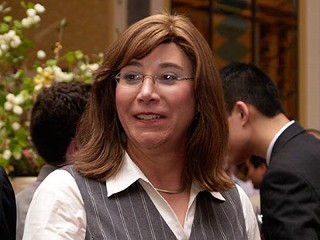
Diane has been fighting to keep her job at the Library of Congress as a terrorism research analyst. The job that was offered to her and then taken away when they found out she was, well, who she was. You see, she went into her job interview as David but she was in transition. When she was offered the job she told them that she would be coming to work as Diane. The next day the offer was rescinded.
Here is an excerpt of her profile:
"Diane Schroer is not one to shrink from a challenge. As an Airborne Ranger qualified Special Forces officer, the 49-year-old veteran completed over 450 parachute jumps, received numerous decorations including the Defense Superior Service Medal, and was hand-picked to head up a classified national security operation. But when she retired as a Colonel after 25 years of distinguished service in the Army, she faced one of her biggest challenges yet: coming out to her friends and family as a transsexual woman."
http://www.aclu.org/lgbt/transgender/12255res20050602.html#profile
Diane and the ACLU have fought a long hard battle, and they have won.
After winning she said this,
"It is especially gratifying that the court has ruled that discriminating against someone for transitioning is illegal," said Schroer in a statement from the ACLU, which represented her in court.
"I knew all along that the 25 years of experience I gained defending our country didn't disappear when I transitioned, so it was hard to understand why I was being turned down for a job doing what I do best just because I'm transgender. It is tremendously gratifying to have your faith in this country, and what is fundamentally right and fair, be reaffirmed."
http://www.cnn.com/2008/US/09/19/transsexual.discrimination/index.html
and this
She added, "I hope, too, that employers, family members, friends and co-workers will begin to understand variations in sexual orientation and identity from a basis of knowledge and not fear."
http://www.abcnews.go.com/TheLaw/Health/story?id=5843396&page=1
This is good news! Thank you Diane. Thank you for putting yourself out there and not giving up. Thank you for being willing to take the fall but keeping the faith. Thank you for ... everything.
Diane has been fighting to keep her job at the Library of Congress as a terrorism research analyst. The job that was offered to her and then taken away when they found out she was, well, who she was. You see, she went into her job interview as David but she was in transition. When she was offered the job she told them that she would be coming to work as Diane. The next day the offer was rescinded.
Here is an excerpt of her profile:
"Diane Schroer is not one to shrink from a challenge. As an Airborne Ranger qualified Special Forces officer, the 49-year-old veteran completed over 450 parachute jumps, received numerous decorations including the Defense Superior Service Medal, and was hand-picked to head up a classified national security operation. But when she retired as a Colonel after 25 years of distinguished service in the Army, she faced one of her biggest challenges yet: coming out to her friends and family as a transsexual woman."
http://www.aclu.org/lgbt/transgender/12
Diane and the ACLU have fought a long hard battle, and they have won.
After winning she said this,
"It is especially gratifying that the court has ruled that discriminating against someone for transitioning is illegal," said Schroer in a statement from the ACLU, which represented her in court.
"I knew all along that the 25 years of experience I gained defending our country didn't disappear when I transitioned, so it was hard to understand why I was being turned down for a job doing what I do best just because I'm transgender. It is tremendously gratifying to have your faith in this country, and what is fundamentally right and fair, be reaffirmed."
http://www.cnn.com/2008/US/09/19/transs
and this
She added, "I hope, too, that employers, family members, friends and co-workers will begin to understand variations in sexual orientation and identity from a basis of knowledge and not fear."
http://www.abcnews.go.com/TheLaw/He
This is good news! Thank you Diane. Thank you for putting yourself out there and not giving up. Thank you for being willing to take the fall but keeping the faith. Thank you for ... everything.
Friday, September 19, 2008
Trouble The Water
This from ColorOfChange.org
"Trouble the Water is a remarkable film that tells a gripping story about two survivors of Hurricane Katrina. It opens in Chicago this weekend, and if enough people go to see it, the chances are greater that it will be released in theaters across the country and spark much needed discussion and real change."
Where in Chicago?
Century Centre, Chicago, IL Fri & Sat, Sept 19 & 20 at 5:00, 7:30 & 10:00pm
Also...
On Friday, 9/19, Tia Lessin will be present for Q&A after the 5 and 7:30 show and will introduce the 10:00 screening
On Saturday, both Carl Deal & Tia Lessin will be present for Q&A after the 5 and 7:30 show and will introduce the 10:00 screening
Check out the website for Trouble the Water.
Watch the trailer below.
Wednesday, September 17, 2008
What Happened to the Intersections? Complicating White Privilege
This is from the blog, Diary of an Anxious Black Woman.
I had to take some time to ponder Tim Wise's "This is Your Nation on White Privilege," which many of my readers had already critiqued when they added their comments in response to his commentary. I, like many others, appreciated the succinct way he cut to the chase and highlighted what is so problematic about the way Americans, and specifically the media, have responded to the different campaigns run by McCain-Palin and Obama-Biden. Yet, the definitions of white privilege were much too simplistic and really didn't get at why it would be easy for a number of voters, including feminist-identified ones, to side with a ticket, indeed a woman, who had no interest whatsoever in upholding feminist principles. It's not simply the workings of whiteness, but also the intersections of gender and class.
Read the rest here!
Sunday, September 14, 2008
Easter - Phoenix Paper
1 Corinthians 15:12 – 19
Harry Potter and the Chamber of Secrets – pages 206 and 207
Today is a day of Easter celebration. It is a day that we celebrate a Phoenix rising. It is a day of celebrating – paper.
Yes, today I bring you the new paper that we made out of the old paper that held the etchings of our pain and sorrow and fractures and whatever else was on them. Today, rising from the shreds, is this phoenix paper. Rising from the tomb of the blender is this Easter paper.
We know that Easter is the celebration of Jesus being resurrected after his death. The Phoenix was a symbol early on in our Christian story. It was used by early Christian theologians about 150 years after Christ. It was a symbol used in early Christian art and literature – it represented the resurrection, immortality, and the life-after-death of Jesus the Christ.
Our faith as Christians is centered on the Easter event – the resurrection. The way that we believe in the resurrection of Jesus may differ from denomination to denomination and from person to person, but resurrection in some form is central to the Christian faith.
In our reading today, in 1st Corinthians, Paul is talking specifically about the physical resurrection of Jesus. He is teaching those in the church who believe that Jesus was raised from the dead, but who for some reason don’t believe that everyone else who dies will be raised from the dead too.
Whatever each of our beliefs is about resurrection from physical death, I believe that we experience death throughout our lives in many different ways. It is the resurrection from those deaths that I want to celebrate today. Specifically, I want us to celebration the resurrection of this paper that represents the death of many of us. While these pieces of paper don’t look like a bird or a holy risen messiah, they look like hope to me.
Look at them – take a good look at them. They are the same pieces of paper that we wrote on and that we shredded, but they are completely different. They are beautiful, aren’t they? They are transformed – resurrected – reborn. These are pieces of Phoenix Paper. They are new and fresh, ready to be used – and yet, they hold within them the past. Like the Phoenix that bursts into flames, turns into ash, and rises from the ash new born, these sheets of paper are fresh and new.
They represent us and the way I believe we are to live this Christian faith. We take who we are, what we’ve been given … all the components of our lives … and we renew ourselves year by year, month by month, week by week, day by day, hour by hour, moment by moment. Verse 19 says, “If for this life only we have hoped in Christ, we are of all people most to be pitied.” If for this life…. If for the life of the past, the life of the moment that we thought made the most sense … if that’s the life that we are going to cling to in our hope in Christ, then we are not fully celebrating the resurrection power of our faith.
I don’t much talk about faith in Jesus. I talk about following his teachings and living our lives using his as an example, but I don’t talk much about faith in him. Faith in Jesus as the Christ is very important to me. His audacious teachings about God and social justice, which led to his torture and execution, which resulted in his resurrection – all of those components combined with the Holy Spirit – are the core reasons that I call myself a Christian.
Jesus as a Christ, one who leads us and who cannot be defeated. Jesus as a Phoenix, one whose life cycles from birth to death to rebirth, who overcomes and overcomes and overcomes. This Jesus, who I celebrate as resurrected every day because I call myself a Christian, this Jesus has demonstrated to us that we too have resurrection power. Because Christ died and rose from the dead, therefore we see what resurrection power looks like and we reach out for it and find ourselves lifted up from the burning ashes of our periodic deaths.
It is a real death, not a supposed one. I think it’s a mistake to talk as if the death wasn’t really a death because there was resurrection. No, it was a real death – often quite painful. But it doesn’t end there. Life begins again. We begin again.
There’s another parallel that I see between the Phoenix and Jesus the Christ – it is the healing powers of both. As we live into our destiny of resurrection, which includes us living our lives in the same power which made Jesus a Christ, we will also flow more powerfully in our destiny as healers. I’m not saying what form this healing will take. There is a lot that need healing and lots of ways to heal. We each have our gifts. But it is, I believe, the power of the resurrection that gives us the hope and the audacity to live into our gifts – these gifts of every type of healing.
Will you celebrate with me and together this specific resurrection – this specific rebirth. We know that there is more to follow, more to think about, more to do … but today, in this moment, it is a time to be joyous and be filled with awe that what was once dead is now reborn, transformed, and filled with the power of hope.
Thursday, September 11, 2008
Planting in September
I am assuming that we all know this date. We all have some terrible memories and feelings that still haunt us. I don't want to push away those memories and feelings, but I do want to live in and have hope for today and tomorrow.
Yesterday I bought seeds. Today, I planted them - well, most of them. So far I have planted Fennel, Basil, and Cumin. Later today I will plant Echinacea and Catnip.
Is my act of planting seeds due to my desire for transformation simply symbolic? I don't think so. Will my planting seeds on September 11, 2008 make a change in the world? Maybe. It is an act of hope. It is also an investment in life. My life. Your life. Non-Human life. All life.
It is also the act of transformation for myself. I am needing to be differently on this day. I am needing to be active and hopeful. My grieving is changing from being devastated to rebuilding. If I begin to rebuild - in the way I talk and the decisions that I make - then my planting seeds isn't simply symbolic. It is one of many steps toward rebuilding, both internally and externally.
Some of you may not be at the rebuilding place. Some of you may be, but don't know that you can. Some of you may be actively involved in rebuilding. For everyone and for myself, I have planted these seeds and will nourish them. They will serve to change the air around me as well as to be a visual reminder that we can and must rebuild.
Friday, September 05, 2008
Help Needed in Louisville, KY for Gustav Evacuees
A friend working in New Orleans sends the alert: “I have heard from two folks in the activist community in New Orleans who evacuated to KY and they have been working to address some issues in the shelter in Louisville. They have made a call out for us to ck with our networks about any contacts in Lousville. They need # 1) lawyers or other legal assistance and # 2) other people who would be willing to get email info and respond by making calls to FEMA, Red Cross, mayors office etc.”
She forwards this appeal:
To the Louisville Peace and Justice Community,
As you may know, there are approximately 1,800 Hurricane Gustav evacuees staying right now in a shelter at the Louisville Expo Center, organized by the Red Cross. While much has been done to provide for evacuees’ needs, as FEMA drags its feet and the evacuation drags on, conditions for evacuees are worsening dramatically.
Please take a moment to call and e-mail:
FEMA Director DAVID PAULISON: (202) 646-3900,
the RED CROSS: (502) 589-4450, and loren.mccamey@louisville-redcross.org.
Louisville mayor Jerry Abramson, (502) 574-2003, http://www.louisvilleky.gov/Mayor/contactusmayor.htm
And tell them that you won’t allow evacuees to be treated this way in your name! Please request that they immediately address the following 4 concerns:
1. Stop police harassment of evacuees. Evacuating is not a crime.
Evacuees have reported harassment from some police officers, merely for walking down the road to the convenience store during the day. They are assumed to be criminals and treated with suspicion and hostility by an ever increasing police presence. The Louisville police should be keeping evacuees safe, not targeting and punishing them during their time of need.
2. Stop unreasonable rationing of food, blankets, clothing and medicine, and give evacuees what they need now.
Due to FEMA’s incompetence, many people lost their luggage and have been wearing the same clothes for almost a week. Yet the Red Cross is only giving out one set of clothes per person, and not everyone has even gotten that. Diabetics have been punished for “hoarding” food when they save snacks to maintain their blood sugar. The Red Cross has piles of food, clothes and blankets, but isn’t giving people what they need.
3. Provide evacuees with up-to-date, accurate information as it becomes available, and provide them with more computers and more phones.
More than anything, evacuees are DESPERATE for information. People need immediate access to phone and internet to find loved ones, check on their homes, apply for FEMA aid, get in touch with employers and landlords, and many other essential and time-sensitive tasks. YET THE RED CROSS AND FEMA HAVE PROVIDED ONLY 20 PHONES and 6 COMPUTERS for 1,800 PEOPLE!
4. AND PLEASE TELL FEMA: Send all evacuees home now, with adequate compensation for money they have lost while evacuated.
Evacuees were brought to shelters across the south by FEMA - who put them on buses and planes without telling them where they were going. In some cases, they were put on different planes than family members, told that they were going to the same city, and then found themselves hundreds of miles away from spouses, parents and children. Gulf Coast parishes, and the New Orleans airport, have all reopened, yet FEMA has yet to get most folks home - or even release a plan to tell them when and how they will get home. Meanwhile, many people have spent everything they had - often dipping into money for rent and utilities - on evacuation expenses, and many have missed work while being stranded so far from home.
FEMA and the Red Cross need to know that people are watching to assure that evacuees don’t have to endure another Katrina. Additionally, the mayor’s office will be open tomorrow, Saturday, from 8am-12pm, so please let them know that you care about how evacuees are treated in your city. And please forward this message to your friends and allies. We very much appreciate your hospitality, and your concern.
In Solidarity,
Renee Corrigan and Nicole Gillies,
The Greater New Orleans Organizers’ Roundtable
Wednesday, August 20, 2008

Sunday, August 10, 2008
The Presence
Ezekiel 48:23 - 35
and
The Color Purple by Alice Walker
Shug and Celie talking about God:
Here's the thing, say Shug. The thing I believe. God is inside you and inside everybody else. You come into the world with God. But only them that search for it inside find it. And sometimes it just manifest itself even if you not looking, or don't know what you looking for. Trouble do it for most folks, I think. Sorrow, lord. Feeling like shit.
It? I ast.
Yeah, It. God ain't a he or a she, but a It.
But what do it look like? I ast.
Don't look like nothing, she say. It ain't a picture show. It ain't something you can look at apart from anything else, including yourself. I believe God is everything, say Shug. Everything that is or ever was or ever will be. And when you can feel that, and be happy to feel that, you've found It.
Shug a beautiful something, let me tell you. She frown a little, look out cross the yard, lean back in her chair, look like a big rose.
She say, My first step from the old white man was trees. Then air. Then birds. Then other people. But one day when I was sitting quiet and feeling like a motherless child, which I was, it come to me: that feeling of being part of everything, not separate at all. I knew that if I cut a tree, my arm would bleed. And I laughed and I cried and I run all around the house. I knew just what it was. In fact, when it happen, you can't miss it.
******************************
I walk around talking to squirrels and birds. I put my hand inside bushes and trees to feel them - not to feel their leaves and their bark, but to feel their life. I reach out to buildings, bridges, and furniture to connect with those who made them. I talk to people that I don't know and try to look at people as I pass them on the street or stand with them in an elevator. I see life all around me. I want to feel it. I want to touch it. I want to embrace it.
There is a heartbeat to this world that is pounding out life continuously. I believe it connects us to each other and to every other living thing. I believe it connects us to our past and to our future. I can't always feel it - but sometimes I can.
This life that I feel and sometimes don't feel but believe is there anyway - this life that connects us and sustains us - this heartbeat, I believe, is The Holy ... Our Creator.
Jesus said crazy things like, "I am the Life" and "I came that they might have life, and have it abundantly." Jesus also talks about abiding with us, even to the end of the age, and that he will send us a Comforter, which is the Holy Spirit that will live with us forever. Our sacred writing promises that there will always be a holy presence living with us and living within us.
At the end of Ezekiel, after all the strange visions and prophesies and bloodshed; after God makes it clear that exploitation and oppression of the weak, the sick, and the scattered is reprehensible; Israel is promised a city that will be divided equally among all the people. It is a city whose name is, "The Lord is There."
There is another city mentioned in our sacred writing. It is in the book of the Revelation. The one seeing the vision and narrating the story describes this city.
Revelation 21:1-8
Then I saw a new heaven and a new earth; for the first heaven and the first earth had passed away, and the sea was no more. And I saw the holy city, the new Jerusalem, coming down out of heaven from God, prepared as a bride adorned for her husband. And I heard a loud voice from the throne saying, "See, the home of God is among mortals. God will dwell with them; they will be God's peoples, and God's self will be with them; God will wipe every tear from their eyes. Death will be no more; mourning and crying and pain will be no more, for the first things have passed away." And the one who was seated on the throne said, "See, I am making all things new." Also the one seated on the throne said, "Write this, for these words are trustworthy and true." Then I was told, "It is done! I am the Alpha and the Omega, the beginning and the end. To the thirsty I will give water as a gift from the spring of the water of life. Those who conquer will inherit these things, and I will be their God and they will be my children. But as for the cowardly, the faithless, the polluted, the murderers, the fornicators, the sorcerers, the idolaters, and all liars, their place will be in the lake that burns with fire and sulfur, which is the second death."
There's a lot in this section. I read more of it than I needed to because I don't want to avoid the ugly stuff, but I don't want to spend a lot of time on it either. First I want say that this is someone's vision - someone's dream maybe. I don't believe this is something to be taken literally. I know that many have though, and it has brought pain and condemnation to people who don't deserve to be hurt and condemned. Second, I don't believe our Divine Beloved will torture people eternally. I don't believe our Divine Beloved tortures people ever. I do believe that the author of this book had a vision and framed it in a way that made sense to them.
What I see as the focal point of this passage is that "the home of God is among mortals." The Holy dwells with us! I see this as being the same city that Ezekiel talked about. It's a brand new city. The old systems of oppression and hierarchy have no place here. If you live in this city, you must agree with the ground rules - all who thirst get water, and all who cry get their tears wiped away. This is not a place that The Holy visits or manages from afar. It is the very dwelling place of the one who is Love.
Alice Walker pushes the point even more, saying through the voices of Shug and Celie that we are connected not only to each other but to all of creation. This connection isn't theoretical, but it is the energy of the Creator itself. Shug says, "it come to me: that feeling of being part of everything, not separate at all. I knew that if I cut a tree, my arm would bleed." This is a form of solidarity that most people are frightened to imagine. She says that "God is everything." If we can believe, or even imagine believing, that God is everything and that we are connected to all of creation, that means that The Holy is present everywhere, or, in other words, that The Presence is.
Think about the Creator, our Divine Beloved, The Holy, God ... whatever name you use ... Think about using the name, The Presence. One Old Testament name for God is "I Am." Another is "The Lord Who Sees." Yet another is, "The Lord Who Provides." All these types of names insinuate a loving and involved Entity ... an Entity that is integrated into life. I want us to imagine this Entity as Presence. The one who sees is able to see because it is present. The one who provides is able to provide because it is present. The one who is ... who simply is ... is present.
That would mean that we are accompanied by the one who has loved, who continues to love and who will always love us. There is a power to accompanying someone. There is a peace that we can offer someone when we accompany them. When you walk a journey with someone and you share their pains and their joys, you are a witness to their life and they are a witness to yours. It goes both ways. So if The Presence is walking with us then we are also walking with The Presence. Our Creator is a witness to our life and we are a witness to the Creator's.
The Presence is the heartbeat of life. It is what I want to feel; what I want to touch; what I want to embrace. The Presence transcends time connecting us to the past and future. This week try living consciously accompanied by The Presence. See if there is a comfort there and a strength. We are the city. We are the dwelling place. We are accompanied by The Presence and at the same time we are to accompany others with our presence. Through us tears are wiped away and the thirsty are offered living water.
Wednesday, August 06, 2008
The Legacy of Slavery: The Cost of Generational Trauma
by Harriet's Daughter

I grew up in a big city in the Midwestern U.S. The neighborhood that I grew up in was a new development of small bungalows going up in a previously wooded, area, so there were woods to play in all around us, but we were really in the city. It was a very attractive place for those who were buying – young black couples who were recently migrated from the south. My parents both had had rural upbringings in the south, as did most everyone I knew in my neighborhood. We grew up knowing “down home” meant the places our parents, many of them with their southern accents, sayings and folkways intact, had come from. We northern city kids inherited much of that upbringing, although our circumstances were different than our parents.
My parents came north to find work and a life that the segregated south would not easily offer (which is not to say that life in the north was all butterflies and rainbows). My dad came, as hundreds/thousands of others did, to work in the auto plants. If I think about it, practically all of my friends had fathers, uncles, cousins that worked in either in auto or steel manufacturing. These were among the first good jobs – union jobs, too – that opened up to blacks. My mom had come because she had family up north already; an uncle and aunt and their kids - from the same small town in Florida she was from. After my parents met and married, they lived in an apartment near my mother’s relatives for a while. This apartment was in a densely populated, inner city area. When the opportunity came up to move to the new house in the neighborhood described above, where there were lawns and woods all around, they jumped at the chance.
While we lived in that house, our personal family migration story continued. Aunts, uncles, cousins – a whole assortment of relatives streamed through, living with us a couple of weeks, a few months or in one case several years, until they found work and settled into their own homes. That’s what happened in lots of families. The chance to buy a home… to own property was huge.
And although in my childhood memory there was plenty of space to roam, in reality these were tiny little houses on tiny little plots of land, in a corner of the city where our families were allowed to live in relative peace. It was starting out as a black neighborhood. However, in other parts of the city, the white parts, when black people moved in, whites moved out. If they didn’t move out of the city altogether to the suburbs, they moved further west – the white side of town.
A while back, Ding over at BitchPhd wrote a post that talked about the importance of land for black families:
The new Skip Gates special on PBS is full of these stories of passing, diaspora, disappearance and reinvention.
What strikes me about some of these early stories of lost family members reclaimed is how prominent black-owned land figures into them and how crucial the land is to forming early black identity as well as ideas of freedom and citizenship. The program begins with Gates visiting the land his family has owned for 6 generations and passes by a parcel of land his family had owned but had to sell. Since part of their own genealogical story is lost to them, their farm acts like an anchor for their identity. In subsequent conversations with celebrities like Chris Rock, Tina Turner, Morgan Freeman, Don Cheadle or Tom Joyner, Gates reveals that their families had once owned land - 40 acres, 62 acres, 65 acres - donating or selling some of their land to build schools or churches. The revelations about property and land ownership become a source of pride in their family.
What is it that Rock says – If he had known this before, it would have taken away the inevitability that he would be nothing. And property is usually the vehicle for these stories to come to light; it acts like a bracket around early black families: you were property and now you have property.
At the turn of the century blacks owned between 12-15 million acres of land; by the 30s and 40s that number shrinks to just a little over a million. For many of these black families the land is a foundation to build their newly acquired identities as freed people that suddenly disappears, forcing their story to jump, only to be picked up further down the line. What happened? What happened in those intervening years? Did African Americans just suddenly decide, “Hm, you know, owning land sucks. Let’s pick up and go north”? Usually something else happened to make a family, or even a whole black town, disperse.
(Read the whole post here.)
She cites Torn from the Land, an investigation into the loss of black families’ land between the period of reconstruction and the Civil Rights Movement:
In an 18-month investigation, The Associated Press documented a pattern in which black Americans were cheated out of their land or driven from it through intimidation, violence and even murder.
In some cases, government officials approved the land-takings; in others, they took part in them. The earliest occurred before the Civil War; others are being litigated today.
Some of the land taken from black families has become a country club in Virginia, oilfields in Mississippi, a baseball spring-training facility in Florida.
The United States has a long history of bitter land disputes, from range wars in the Old West to broken treaties with American Indians. Poor white landowners, too, were sometimes treated unfairly, pressured to sell at rock-bottom prices by railroads and mining companies.
The fate of black landowners has been an overlooked part of this story.
The AP — in an investigation that included interviews with more than 1,000 people and the examination of tens of thousands of public records — documented 107 land-takings in 13 Southern and border states.
In those cases alone, 406 black landowners lost more than 24,000 acres of farm and timberland plus 85 smaller properties, including stores and city lots. Today, virtually all of this property, valued at tens of millions of dollars, is owned by whites or corporations.
Properties taken from blacks were often small — a 40-acre farm, a modest house. But the losses were devastating to families struggling to overcome the legacy of slavery.
Anti-racism education makes the connection between white privilege and generational wealth. This flies in the face of the American myth of “pulling oneself up by one’s bootstraps.” In this society, poor people are blamed for their poverty – the reason people are poor, we think, is because they are lazy, or they don’t have good judgment, they have poor morals or they just are not smart. We don’t acknowledge that generational wealth (as one example – there are many others) makes a huge difference in the life of an individual (and therefore a family, and thus a community), and this is absolutely connected to having property. When people have property that they can pass on to their children or other relatives, this makes a difference.
Of course, it is not only about owning land, which is not a universal concept, anyway. When people don’t have to pull up stakes because no one will hire you because of the body you inhabit, this makes a difference. When people move out of neighborhoods that suddenly become “undesirable” this makes a difference.
So it is not only the monetary value of the land. The ability to move freely about is a kind of capital, too. It is knowing that you belong somewhere; that you fit in, that you have an identity and being treated accordingly. It is the ability to not have your very presence be so offensive to people that they want to annihilate you and those who look like, or act like you. And so, while I am reflecting here upon the past, this is not simply a story of the past. People who inhabit bodies that are considered “wrong” are fair game for mistreatment. Some bodies do not matter… not then, not now.
Native peoples, whose identity is closely connected to the land, were murdered or run off land they had inhabited for centuries. Of those who survived, many of their children endured “kill the Indian, save the man” campaigns that were meant to “civilize” them; make them American, make them white… by denying their language, cutting their hair, keeping them away from their communities… so much more. Refusing to abandon their cultures cost them the right to move freely about in wider society. The trauma of this sustained pattern of genocide is evident today.
For my people, the descendants of Africans who were enslaved, there is a different story, but a parallel one. Enslaved people owned no property; they did not even own themselves. Even their children and their partners, (should they be allowed to marry), could be taken away from them in an instant - sold away to someone else. Even our names do not belong to us. There are not many generations that I can count in my family tree; there is no land that I can point to and say, “This is where my people come from.” Several years ago, my daughter and I visited Nigeria – it was my first trip to an African country. While we were there, many people welcomed us, welcomed us “home.” But one man I talked to spoke the truth when he said that he had sorrow for African Americans, because we “do not know where our village is.”
I do not know where my village is. Does it matter? Should it matter? On the surface, perhaps it does not. I prefer to live in a world where I can connect to people beyond the fact of shared bloodline – after all, I am the mother of an adopted child. I have friends whose ties to me run much, much deeper than blood. I want to create a world where people do not align themselves into tribes with boundaries that cannot be breached, whatever those boundaries happen to be. Yet, I cannot help but believe that the combination of this “homelessness” and the reality that my people have been reviled for most of our history in this country feed into a communal psyche that is damaged and goes untreated.
My parents grew up under the system of segregation. They saw the signs that said “colored” and “white.” They learned the corresponding message that they were thought to be so … what? Inhuman? Unclean? Diseased? …that they could not share space - eat… work… watch movies… worship – with white people. What does that do to a people, generation after generation? Yet we are told slavery was a long time ago, segregation is illegal. Get over it. Move on.
I believe this is a wound that has not been healed in the souls of my people. I don’t know that it can be. Last Tuesday, the U.S. House of Representatives passed an official apology for slavery and segregation. Reparations were not mentioned as part of the apology – I believe the resolution would never have made the floor had they been. Many people believe an apology without the offer of restitution is meaningless. Perhaps so. But the acknowledgement that it happened, and it was wrong, and that the repercussions are long-lasting…. is a tiny bit of salve on that wound.

Friday, August 01, 2008
The Future Depends on Memories
Ecclesiastes 11:7 – 12:14
A little over a week ago, I went to see the Rev. Dr. Renita Weems speak. Dr. Weems is a nationally-renowned theologian and an ordained elder in the African Methodist Church. She has been a member of the faculty of Vanderbilt University and Spelman College, and she has been celebrated by Ebony Magazine as one of America's top 15 preachers. She touched on a variety of subjects that made me think and double-think. One such double-think nugget for me was her reference to research that says grown women have a harder time sticking with an exercise program when they did not exercise when they were kids. Apparently they are finding that having no memory of past exercise makes it harder to exercise in the future. Picking up something from scratch is hard when you're an adult.
The word, remember, is important in our reading today. "Remember your creator in the days of your youth." Remember your creator BEFORE the days of trouble come and BEFORE the sun and the light and moon and the stars are darkened and BEFORE the silver cord is snapped and the golden bowl is broken. Remember your creator BEFORE the bad things happen. If you have no memory of your creator before the bad things happen, how will you have memory of your creator WHEN they are happening?
Just like kids who avoid exercise when they are young find it difficult to exercise when they need to ... when they are older and their metabolism slows, if we avoid things like prayer or meditation; practicing love, forgiveness, and humility; and being thankful to our Divine Beloved - if we avoid those things when all is well, how will we remember to do them when things get difficult? It's hard to start love from scratch when you have no memory of loving. It's hard to pray from scratch or have spiritual conversations with your friends when you have no memory of doing these things. Often these things don't even come to mind at the most critical times.
Things like prayer, meditation, love, forgiveness, repentance – these aren't just religious ideals for which the ultimate spiritual person strives. These are coping skills. They are the coping skills of people of faith.
Just before the character of Solomon tells us to remember he says, "Banish anxiety from your mind, and put away pain from your body; for youth and the dawn of life are vanity." Youth and the dawn of life don't last, that's pretty clear from this verse I think. But what does banish anxiety from your mind and put away pain from your body mean? I would like very much to do that. I have pain in my body that I'd like to put away and anxiety that I'd like to banish. How about you? It isn't that easy though. Do you just say, "Anxiety, you are hereby banished!" and it all goes away. I believe in miracles ... I do ... but I can't seem to make stuff like that happen just by making a declaration.
But maybe I can make things a little easier on myself if I practice taking care of my body, spirit, emotions, and mind while I am in a good place. That way when pain occurs or anxiety starts to get in the way I have developed a habit of better responses. When a crisis happens and I am already in the habit of prayer, I am much more likely to pray during the crisis. I know of a man who prayed in tongues daily. One day he was at the dentist office and had to have oral surgery. The story goes that while they were putting him under he started praying in tongues. It was just what he did.
I can tell where I am in my prayer life based on how I react to a crisis situation. A few years back I hit a deer. As my vehicle was careening down the highway I started praying asking Jesus for help. It was involuntary. On the other hand, I have been known to involuntarily spew out some, let's call them "unsavory words," in other crisis situations such as when I stub my toes. I hate stubbing my toes. It really really gets to me. I don't always shout out, "Oh Jesus help me."
When it isn't my pattern to remember my Divine Beloved, I'm not going to remember to remember in a crisis. I won't remember when the day of trouble comes if I don't remember before the day of trouble. The day of trouble doesn't put me in a reflective mind ... "Well now, what might be the best way to handle this sticky situation?" That is not what I'm thinking. In fact, we don't tend to think in those situations. We just react. We go to our default.
When life isn't hard is when it's the most crucial to practice our faith. Rest assured life becomes hard sometimes. Church life becomes hard sometimes. Our faith gets challenged at every level. Every church has hard times - times of crisis. This church has had hard times. Living through a crisis takes its toll. We need to keep remembering our creator. We need to keep practicing our faith both at home and within our community. I think it's easy to get out of the habit when the crisis is over because we need to fall out for awhile.
We are all in different stages of healing. We are also in different stages of crisis. While it is difficult to start our faith from scratch during hard times, it isn't impossible. The fact that you are here at church means that you are remembering the importance of community in your life. I'm not saying we all have to go to church every single time there's a meeting. I do want us to think about our habits though. What is your (and my) tendency? What's going to happen with me the next time I stub my toe? What will happen with me if I hit another deer?
No matter where we are in our crisis or healing of anything, we have to remember now. Because if we remember now ... we won't have to remember later. The memory will find us.
Deuteronomy 6:4-12
Hear, O Israel: The Lord is our God, the Lord alone. You shall love the Lord your God with all your heart, and with all your soul, and with all your might. Keep these words that I am commanding you today in your heart. Recite them to your children and talk about them when you are at home and when you are away, when you lie down and when you rise. Bind them as a sign on your hand, fix them as an emblem on your forehead, and write them on the doorposts of your house and on your gates. When the Lord your God has brought you into the land that he swore to your ancestors, to Abraham, to Isaac, and to Jacob, to give you - a land with fine, large cities that you did not build, houses filled with all sorts of goods that you did not fill, hewn cisterns that you did not hew, vineyards and olive groves that you did not plant - and when you have eaten your fill, take care that you do not forget the Lord, who brought you out of the land of Egypt, out of the house of slavery.
When things are going well, don't forget. Do whatever you have to to remember. How do we create these memories? What do we practice? What does it mean to pray or to love? How do we remember to be humble and thankful? Some of you may already have daily or weekly practices. I like to do braiding and knotting as a meditative practice. I also have a meditation moment when I brush my teeth. I don't think about what I'm going to pack for lunch or if I'll find matching socks. It's a way for me to focus on the moment I am in rather than the moment I might be in next. It's a small way ... but for me it helps to remind me that I want to be present in as many moments as I can throughout the day.
According to Deuteronomy, do whatever you have to. Put sticky notes on your computer or bathroom mirror of favorite verses; sing songs in the car that remind you how best to walk your faith; talk to each other about your faith, actively see people you come in contact with as being holy and sacred; look in the mirror and remind yourself that you are holy and sacred. You are holy and sacred, you know ...
Forgive the person who swipes your parking spot - the one you've been circling around to find for the last 15 minutes; forgive yourself for things you would beat yourself up about; thank the Creator for the grass or the trees or the lake; thank the Creator for having running water and electricity if you have it.
All of these are coping skills that you are developing for when the time comes and "the silver cord is snapped and the golden bowl is broken."
One day I was walking into the downtown office building where I work, and as I turned the corner toward the elevator with a UPS woman next to me, the elevator opened up. Spontaneously - because I was in a good place - I said, "Thank you, Jesus." The UPS woman said, "Amen!" From the security desk I heard the voice of the head of security say, "Gus pushed the button." Of course I thanked Gus for pushing the button for us. But that reminded me to thank people for the little things - for pushing the elevator button or holding a door open. This may sound simple and maybe trivial, but it isn't. These are ways of practicing. Here's another thing that I've found to be really helpful in my faith walk - I try to remember to smile, especially when I enter a room. If I find myself forgetting, I write the word "smile" on my hand. Smiling can change your whole day.
Verse 9 of chapter 11 in Ecclesiastes tells us to rejoice. Throughout the book we are reminded to Eat, Drink, and Be Merry. Enjoy this life the best you can. It isn't hedonism - it's good faith practice. If you are in the habit of enjoying what you can that's in your life, then when things get messed up, you have a foundation of joy or at least the ability to smile.
Sure there are some intense things you can do. You can go to the gulf coast to help repair the damage there; you can go on a retreat; you can volunteer for an organization - but it's the daily practices that help us develop the coping skills we need for the daily and the unusual crisis. It's also the daily practices that help us know when we need to do something more intense. This week look for the moments when you can actively remember your Creator ... your Divine Beloved. Think about what Deuteronomy suggests to, "Recite them to your children and talk about them when you are at home and when you are away, when you lie down and when you rise. Bind them as a sign on your hand, fix them as an emblem on your forehead, and write them on the doorposts of your house and on your gates." Think of ways to remember today, so that in the future the memory will come to you when you need it.
Monday, July 21, 2008
Do It Anyway
My sermon from July 20, 2008
Ecclesiastes 10:1 – 11:6
This week's text is filled with practical advice, analogies, consequences, and challenges. Having grown up on a farm, I know the truth of an iron, such as an axe, needing to be whet, or sharpened, so that you don't have to exert as much force. And I know that at some point, if you are splitting logs, you will get hurt by one of them. It isn't about not getting hurt as much as it's about not getting hurt badly.
Verse 11 of chapter 10 talks about not needing a snake charmer if the snake bites you first. The elders in my family had a similar saying, "No point closing the barn door once the horse is out of the barn." That's what they would tell us kids. It is the same as saying, "too little too late." We were being taught to look ahead, make plans and provisions, to think about consequences - stuff like that.
One of my favorite proverbs is Proverbs 14:4, "Where no oxen are, the crib is clean: but much increase is by the strength of the ox." When I first read this at 15 years of age I had been pitching manure for years. I also knew that before there were tractors, farmers used oxen to plow their fields. What I considered to be the true meaning of this scripture was not lost on me. This proverb is a metaphor to talk about what's worth doing and what isn't worth doing. If eating in winter is a priority, then maybe it's worth pitching some manure in the summer. There are trade-offs to everything. You have to decide what is most important to you.
Being a part of a faith community is no different. There are some inevitable consequences to joining yourself to other people spiritually and seeking The Holy together. There is a vulnerability to doing this that at some point will end up with you being hurt by someone or hurting someone. Sometimes it happens because of wrongdoing and sometimes it's just because it hurts to be vulnerable. Being part of a faith community costs you time and money and love and ... what else? You know what it costs you. And you do it because you want to. I hope you want to. You do it because it is more important for you to be a part of this community than it is for you to hang on to whatever you might otherwise hang on to. There are trade-offs to everything.
What we read today in chapter 11 is important to keep in mind when we're thinking about these things - things like consequences and trade-offs. The character of Solomon is encouraging us to go into our endeavors with our eyes open, knowing the costs and the hazards, but with all that, we are told to get involved with the endeavor. "Send your bread upon the waters; divide your means; and plant your seeds." In other words, do stuff. Sending your bread and dividing your means is thought by scholars to be metaphors for doing charity. Do stuff - do good stuff.
We don't know how it will all work out. Do it anyway. Verse 4 says, "Whoever observes the wind will not sow; and whoever regards the clouds will not reap." If we wait for the perfect time or the right environment or the perfect/right anything, we'll end up doing nothing.
In "Letter from a Birmingham Jail," dated April 16, 1963, the Rev. Dr. Martin Luther King Jr. said, "We know through painful experience that freedom is never voluntarily given by the oppressor; it must be demanded by the oppressed. Frankly, I have yet to engage in a direct action campaign that was "well timed" in the view of those who have not suffered unduly from the disease of segregation. For years now I have heard the word "Wait!" It rings in the ear of every Negro with piercing familiarity. This "Wait" has almost always meant "Never." We must come to see, with one of our distinguished jurists, that "justice too long delayed is justice denied." The work of Dr. King would have been thwarted had he listened to the word, "Wait."
You might be thinking, "Now pastor, that's really intense." And you'd be right. What Dr. King did was very intense. I'm not saying that we are on the pinnacle of some great revolutionary movement, although I do believe that such things as feeding the poor and sheltering the homeless are in fact revolutionary acts. But I don't want to talk about the acts themselves right now. I am lifting up Dr. King to say that here is a man who did amazing things against all odds, and with enemies on all sides. White men who claimed they were on his side told him to back off and that what he was doing was wrong. What Dr. King was doing was scary to these white so-called allies, and way too aggressive. Dr. King knew that he had to press on. That timeliness was a convenience of those in power. He knew what resources he had and he used them as frequently as he could.
I have questions for us today. What are our resources? What is our passion? How do we want to engage in this world? Financially ... well, let's just say that there are churches better off than we are. So what! Money may not be our resource. What is the bread that is our charity? What are the means that we can share? What seeds do we have as a community? Maybe our bread is experience. We have just had our 20th birthday as a church! We have a legacy in the American Baptist denomination. We know how to struggle with being outcasts. We have been a leader in the fight for the inclusion of queer people in Christianity. We are also leaders in knowing how to love. I see it every week. I see it in your eyes as you look at one another. I see it in the way you offer each other prayers and the elements of our communion table. I see it as you welcome visitors. I see it as you reach out beyond your comfort zone. Yes, I see it here.
We need to bring it out there. We need to figure out our resources so that we can reach out in love to those who don't feel love. I don't care about making converts. I care about offering community to people who feel isolated. I care about getting the word out that we are still here and that we are strong. I care about taking steps forward and not waiting for the right time, because there may not be a right time. Verse 6 says, "In the morning sow your seed, and at evening do not let your hands be idle; for you do not know which will prosper, this or that, or whether both alike will be good." We do not know.
In the 14th chapter of Matthew there's a familiar story about Jesus walking on water.
And early in the morning Jesus came walking toward them on the sea. But when the disciples saw him walking on the sea, they were terrified, saying, "It is a ghost!" And they cried out in fear. But immediately Jesus spoke to them and said, "Take heart, it is I; do not be afraid." Peter answered him, "Lord, if it is you, command me to come to you on the water." He said, "Come." So Peter got out of the boat, started walking on the water, and came toward Jesus. But when he noticed the strong wind, he became frightened, and beginning to sink, he cried out, "Lord, save me!" Jesus immediately reached out his hand and caught him, saying to him, "You of little faith, why did you doubt?"
It's so easy for us to be like Peter. We might be in the middle of doing the most amazing and wonderful thing and the next thing we know, we feel like we're drowning. We think we're following the very voice of Jesus and then we look at the wind and it's a strong wind and it scares us. Why do we doubt? Is it because we think everything we do should be successful or else we are failures? Do we think if there's resistance, circumstantially or through people, that maybe we should take that as a sign? The story of Peter does not teach us this. Peter didn't even pray that his walking on water be "God's will." Neither did he ask permission. This was a test Peter was giving to Jesus. "Hey man, if it's really you then command me to join you." That's some gutsy talk. But Jesus did it. And Peter followed through. This story also teaches us that when we falter that we can be lifted up. "Save me," Peter shouted.
Following the way of Jesus is a risk-taking venture. Joining a community of faith is a risk-taking venture. Engaging in society is a risk-taking venture. But we can choose the depth of the risks we take. Who do we want to be? Do we want to be leaders? Do we want to love those that others have rejected? Do we want to think outside of our own pattern of doing things to become a force of love to be reckoned with?
I want to walk on water. I want to plant in the morning and at night. I want to learn how to give the resources that I have and not wish for the resources that I think I need. I don't want to wait for the right time because I think that "wait" means "never." I want to follow the way of my teacher, Jesus and my brother, Dr. King.
What ideas can we come up with to make a difference and to let people know that we are a vibrant loving community of faith? What do you think about starting a community garden in one of the city lots and working with queer homeless youth - teaching them how to grow things and giving them the food to eat that they grow. What do you think about starting a support group for battered women? What if we figured out how to restart the coffee house that we used to have? Maybe we could start a choir with the queer homeless youth? I'm just throwing out ideas. What are your ideas? What are your talents? How much time do you have? When can we start?
I'm not sure when our next community meeting is, but will you be there? Will you come and share in the food and brainstorm with us? This is what I think church is. Sure, we gather together on Sunday to encourage one another and to get energy and to remind ourselves that we have something to offer, but it's our whole life that is involved. We can make a difference. I know we can.
Sunday, July 13, 2008
But I Thought ...
This is my sermon from July 6, 2008
Wickedness and Righteousness are not always so clear cut. We think we know what they are and then we meet someone who confuses us or changes our minds. Sometimes we meet our own self and we find out what we were categorizing as righteousness is actually better defined as wickedness - or - that what we defined as wickedness is really more righteous than our righteousness.
Jesus was, and still is, difficult to categorize. The religious leaders of his time disagreed with the common folk, accusing Jesus of such things as being a leader of demons, being a drunkard, and carousing with prostitutes and other sinners. Jesus' followers, however, believed he was sent by God - that he was doing righteous and holy things. Today, when we actually read the words that are attributed to him, it's not always clear what he wants us to understand or learn.
Today I want to talk about expectations and how they become easily foiled - the expectations that Paul had for himself; the expectation of Jesus; the expectations of the writer of Ecclesiastes, and finally, our own expectations.
Let me speak to you for a moment as a Cubs fan. I know that not everyone in this room is a Cubs fan, and I'm not out to convert anyone. It's just that this year we have some high expectations. It's true that every year a Cubs fan has expectations, but this year they have become especially high. Not since 2003 have we been so hopeful. This year, when we swept the Sox at Wrigley Field, I was expecting us to at least win one game against them at Sox Park. Naive? Probably. But I'm a Cubs fan. I have these hopes and dreams and, yes, these expectations. I know that winning the World Series will not bring about the Kingdom of God, although I have heard one interpretation of the Lion laying down with the Lamb as the White Sox playing catch with the Cubs.
What about more serious subjects. What about racism? Now that we have a black man running for the office of the president, there are some folks who have the expectation that that means racism is a thing of the past. The black folks don't so much think this ... it's us white folks who have this idea. We want to say, "See, there is no racism. Look what that (mostly) black man has accomplished." Then, if we listen, we hear our dark skinned sisters and brothers pointing out the racism that they experience in their own lives.
A woman almost got the nomination. Does that mean that the fight against misogyny is over? Queer folks have their own parade. Does that mean the fight against heterosexism and homophobia is over? Jesus rose from the dead conquering sin and death. Does that mean our fight against sin and death is over?
It's just not how it works, is it? We think when we get to "this" certain place ... whatever that place is ... that it will be evidence that we've fought the good fight and won. When we finally get to "that" place, we find that our expectations haven't really been met. It's disappointing - sometimes disheartening.
Last week a woman named Esmin Green - a poor, black, mentally ill woman - was brought to a New York City hospital. She needed treatment. Have many of you heard about this in the news? It's a devastating story. She died on the floor of the hospital waiting room. It's recorded on the hospital's surveillance camera. She was lying on the floor for an hour. People walked by her, both medical personnel and other patients. No one helped her. No one cared enough about her because she was poor and black and mentally ill. One would think once you get to a hospital that you'll not die on the floor of the waiting room. One would think that once we have a black man running for president that this kind of thing would not happen to a black woman. One would think a lot of things ... and their, or rather our, expectations would be dashed.
I have a love/hate relationship with expectations. I know that they are practical to have, such as when you set goals or make plans. I had an expectation that I would preach here today. Some of you may have been expecting to see me here today. There's nothing wrong with making plans. I think it's the investment that we make in the plan that gets us into trouble. The higher the investment, the more disappointed we become when our expectations are foiled.
Think about the disappointment of Jesus' followers with each strike of the hammer as he was being nailed to the cross. They had invested everything in the idea that Jesus was the Messiah who would save them from their political and religious oppressions. Sometimes our expectations keep us from listening. Jesus never promised them freedom from the fight. He promised them the fight and that they could have peace and freedom while fighting.
The writer of Ecclesiastes seems to be saying, "You know, I thought the wicked were supposed to die young and the righteous were supposed to be wealthy and grow old. This isn't what I expected at all." We often overlay our expectations onto life. When someone is poor, they must not be working hard enough or they're not very smart. When someone uses a handicap spot, even if they have a handicap sticker in their car, but they have no discernable symptoms, we may assume they are a jerk. Disease looks like this and poverty looks like that and wealth looks like this other thing ... and so it goes.
Real life doesn't bear these things out, and then we struggle to reconcile our expectations with what is really happening around us. Paul struggles with this in Romans 7 when he says, "For I do not do the good I want, but the evil I do not want is what I do." He can't even reconcile his own actions with his core beliefs. And frankly, often, neither can we. In Matthew's gospel Jesus is perplexed and angry. People don't recognize what he thinks should be obvious - who John is and who he is. He sounds heartbroken me - heartbroken and angry. The character of Solomon struggles with disappointment in Ecclesiastes. He says, "When I applied my mind to know wisdom, and to see the business that is done on earth, how one's eyes see sleep neither day nor night, then I saw all the work of God, that no one can find out what is happening under the sun. However much they may toil in seeking, they will not find it out; even though those who are wise claim to know, they cannot find it out."
As we come to the Table today - as we commune together - what are our expectations of what this means? Can we, today, try to put away everything that we think we should think and feel about this? Can we peel away the layers of time and experience that may have dulled our ability to observe the moment and fully participate in the now? If we can do that here, in this vital ritual of our faith, can we then take it outside these walls and observe the now more fully as we live our day to day lives. If we can do that, might we know better who John the Baptist is? Might we recognize Jesus? Might we notice Esmin Green? Might we see each other, our neighbors, our friends, and our foes for who they are and not who we have decided them to be?
I think we will. And, I think if we give ourselves to this practice, we will also know ourselves a little better too. We will become less anxious about our expectations being met because we will have less investment in the expectations and more investment in observing what is right in front of us. I think this is one of the ways that we change the world - one of the ways that we usher in the Kingdom of God. The way is this - We live in now. We feel the power and the truth of now. We work and change things now. We love, now.
Sunday, July 06, 2008
Mixed Messages - June 29th Message
Gay Pride is complicated. According to some religious folks and in some places in the Bible we are told that Pride is a sin. On the other hand, we are also taught to take pride in such things as our work or our family. Our English word Pride isn't very specific. Merriam Webster has 6 separate definitions of the word Pride. This is the first definition:
PRIDE
1: the quality or state of being proud: as a: inordinate self-esteem : conceit b: a reasonable or justifiable self-respect c: delight or elation arising from some act, possession, or relationship
Doesn't that sound like 3 definitions? But that's just the first one. Pride is complicated and contradictory.
Ecclesiastes is also complicated and contradictory. I love this chapter because it's so messed up. It's so crude and human. The character of Solomon simultaneously tells us not to be either too righteous or too wicked and then turns around and scorns all women for being unable to meet his standards. He also tells us that death is better than birth and then tells us that death is bitter, but not as bitter as a woman who is a trap. It isn't a woman who lays a trap - the woman herself is the trap. And according to the rest of the chapter all women seem to be this way.
This teacher we've been studying, presumably male, claims to have found one man among a thousand who can meet his standard. Well, Happy Pride everyone. No wonder he finds women to be a trap! This guy's gay and he's blaming it on women rather doing what he has been instructing us for the last few chapters ... to eat, drink, and be merry.
Pride is complex and contradictory. Ecclesiastes is complicated and contradictory. We are complex and contradictory. Each one of us individually and each one of the communities we belong to is complex and contradictory.
As most of you know, I have had a lot of therapy. I'm grateful for that. If you find a really good therapist it's wonderful. I've been lucky to find a few good ones. In one of my sessions with my last therapist a few years back I was troubled because my girlfriend at the time was railing on me for having mixed messages. I didn't know what she was talking about. My therapist listened to my story and finally said, "There's a reason she thinks you have mixed messages, and that's because you have more than one message." I was stunned. I felt guilty and shameful. Quickly my therapist continued. She said, "You have more than one message because you want more than one thing. We all do."
Friends, I learned that anyone who thinks they have one message is lying to themselves. What we need to do is find out what those messages are ... not pretend that we don't have them. When we read any sacred book, especially our own, we need to remember that it too has mixed messages. It doesn't help us to justify them. I think the best thing we can do is look right at them ... look right at the complexities and the contradictions.
My own belief system is riddled with contradictions. I believe that Jesus is our savior – that he is sacred and holy – and I love to worship him. At the same time I believe that Jesus was a human man who was a political and religious revolutionary and that we are all called, like him, to be saviors in our own time. I believe we are all sacred and holy. Does that mean I need to stop giving in to the ecstasy of worshiping Jesus or that I should start worshiping you? It's complicated and there are contradictions.
I have mixed messages. Jesus had mixed messages. The writer of Ecclesiastes had mixed messages. Every one of us has mixed messages. Many of us are queer and proud. At the same time we all make choices when we will come out to people. If we had one message wouldn't we come out to everyone all the time? Life isn't that simple. We have to make choices. Does it negate our pride when we decide not to be forthcoming about our sexual orientation or gender identity? Not necessarily. What's the difference between deceit and prudence? What's the difference between pride that is inordinate self-esteem and pride that is reasonable or justifiable self-respect? At what point is labeling ourselves a badge of honor and acceptance and at what point is it a box that we put ourselves in?
The parade itself has mixed messages. It is both a parade of protest and a parade of privilege. When we march as a church we are protesting the hetero-normative standard of family and faith. This is good to do. I think we also need to be aware that we are staging this parade in a very privileged way. When the fundamentalists are on the side lines with their banners and bull horns we get mad at their audacity and ignorance. Yes, they are audacious and ignorant - I agree with that 100%. However, even if their prejudice and hate is acceptable to many, there are laws that state they are not allowed to hang us or burn us or otherwise cause us physical harm. These laws don't change anyone's heart, but sometimes they protect us. The laws don't protect us all the time. There are enough people with legal authority who will overlook evidence or do any number of things to save their own from punishment, but at least we have something in writing to work with. There are gay pride parades around the world where they are protesting with the hope of getting some of the laws we take for granted. Just for being in the parade these people get put in jail, stoned, or hanged. When we march here, with the freedoms that we have, we are marching on behalf of those who can't. We are demonstrating to the world that there is freedom to be had. We are inciting others who do not have our freedom to go after it for themselves. Sometimes they die trying. Sometimes we do too. When we use our privilege as a chance to protest, isn't that a sort of mixed message? Doesn't it complicate the event? I hope it does. And I hope that we can wrestle with those contradictions and complications.
Peace isn't having a simple message. Freedom isn't about every one being nice to one another and getting to party. Privilege isn't about finally getting to take it easy. All of these ideals are complicated and filled with contradictions. I think the character of Solomon got it right in verses 15 - 18, "In my vain life I have seen everything; there are righteous people who perish in their righteousness, and there are wicked people who prolong their life in their evildoing. Do not be too righteous, and do not act too wise; why should you destroy yourself? Do not be too wicked, and do not be a fool; why should you die before your time? It is good that you should take hold of the one, without letting go of the other; for the one who fears God shall succeed with both."
Many, in their wickedness, have declared us wicked! So friends, in our peace-seeking and freedom-fighting let us take hold of our righteousness alongside our wickedness. In our privilege let us fight against oppression. And above all, let us remember that the one who respects and loves God succeeds, both with wisdom and folly, with righteousness and wickedness. We need to let our love for our Divine Beloved motivate us in our righteousness and our wickedness. As you move through this world, take hold of one without letting go of the other.
Wednesday, July 02, 2008
Esmin Green - Death By Racism and Classism
First, I want to direct your attention to Womanist Musings - http://www.womanist-musings.com/2008/07/esmin-greenyes-she-mattered.html
Second, I want to tell you the little that we know about Ms Green. She was black. She was poor. She was mentally ill. She died alone in a room full of people, including health professionals who ignored her. There is a video surveillance of her death in the hospital waiting room.
Third, I need to say this ...
The blatant disregard for Ms. Green's humanity and sacred worth makes me want to vomit. It also makes me want to storm the temple of whiteness and capitalism with a cat o' nine tails. Ms. Green wasn't going to make anyone any richer or feel any whiter than they already were or felt, so they let her die on the floor of a hospital waiting room.
This is a Disgrace! This is Shameful! Had this been a middle class white man would this have happened? How about a middle class white woman? I doubt it. We treat our pets better than we treat the Esmin Green's of our communities. It isn't enough to finger point at New York or at whatever hospital she was it. What are we going to DO?
Will each one of us, especially each one of us white people, take the time to look for the Esmin Green's who are laying on the floor of hospital waiting rooms and ask someone for some HELP? Will we notice people on the subway? In the alley? On our streets where we live ... no, where they live and where we walk from and into our houses?
I am not simply suggesting that we "righteous white people" help those poor black people. I am calling upon us to connect with our siblings; to love because not loving is being abusive; and to see the people that the system of white middle class privilege has rendered invisible.
Will you? Will you do it?
Subscribe to:
Posts (Atom)


 Posts

